
Capacity and layout
Sizing, outlet count, and slope for the roof area they actually serve.
Exteriors · Gutters / Arkansas
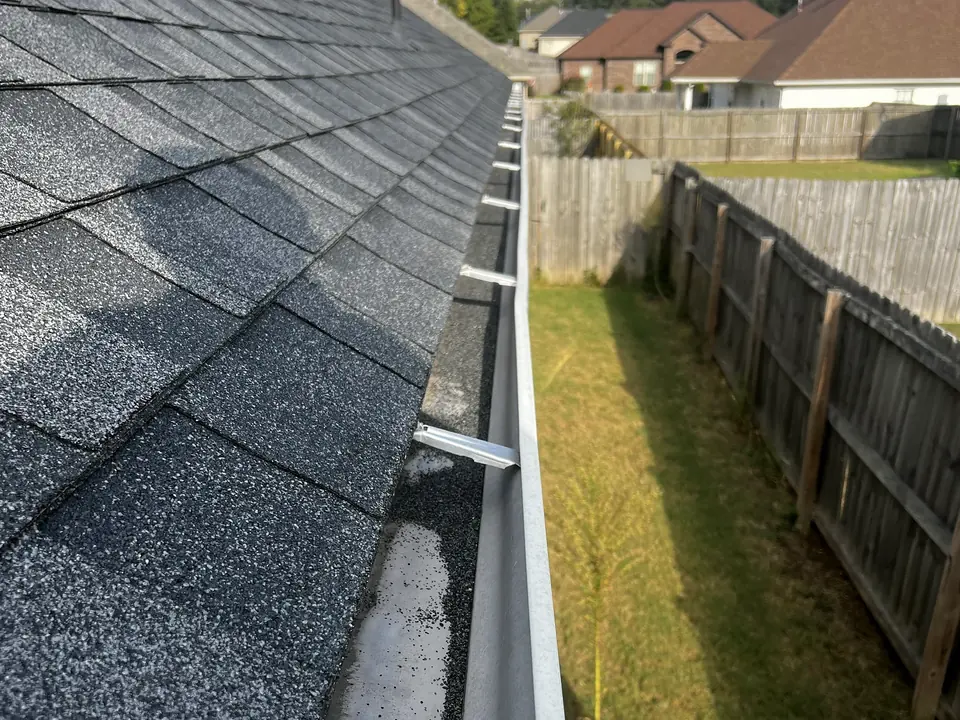
Gutters are usually measured against the roofline. Water, on the other hand, arrives at the ground — and where it goes next decides whether a gutter system is doing its job.
Let’s discuss your propertyA thoughtful starting point
Sizing, outlet count, and slope for the roof area they actually serve.
Where water is discharged, how far from the foundation, and where it can go safely.
Sagging sections, failed hangers, seams, fascia, and pitch.
How the gutter meets the roof edge, drip edge, and shingle line.
Water / A path with purpose
The roof surface directs water toward the edge.
Gutters guide runoff toward a planned outlet.
Downspouts and site conditions determine where water goes next.
01 / Where problems come from
Overflow is usually a design problem before it is a cleaning problem: a section sized too small for the roof it serves, too few outlets, or a run pitched toward the wrong end. Debris makes it worse, but it is rarely the whole cause.
The other half of the system is below the gutter. A downspout discharging at the foundation moves the problem rather than solving it, and a gutter that has pulled away from a fascia it is meant to protect is no longer protecting anything.
02 / Replacement or repair
A section that has separated, corroded through, or pulled off its hangers is a replacement candidate regardless of age. Gutters are inexpensive compared with the water problems they cause, but the real cost is usually doing the same section twice.
If only one run is affected and the rest of the system still performs, a matching repair can be reasonable — provided the material and profile match what is already there.
03 / Gutter guards
Guards reduce the amount of debris entering the system. They do not fix undersized sections, too few outlets, bad pitch, or discharge points that already send water toward the foundation.
That is why we look at layout before recommending a guard. On a system that is correctly sized and pitched, guards help. On one that is not, they simply delay the overflow.
The Alden Stone approach
One point of guidance. A considered path from the first inspection through completion.
Take a closer look at the property and the visible conditions.
Make sense of the findings, the priorities, and your questions.
Define the scope, materials, and practical next steps.
Bring the right people and details together as work moves forward.
Review the work, the details, and the path ahead.
A little more clarity
Visible separation at the seams, sagging runs, failed hangers, recurring overflow, or rust and cracking are the practical signs. Tracing where water goes during rain shows which of those are actually causing the problem.
They help on a system that is properly sized and pitched, because they reduce debris entry. They cannot correct insufficient capacity, missing outlets, or poor discharge locations.
Far enough from the foundation that water leaves the property rather than collecting against it, and in a location that will not erode the ground or discharge against neighbouring structures.
Not always, but they are easiest to coordinate when the roof edge work is already underway, since both depend on the same drip edge, fascia, and roofline condition.
Alden Stone / Your next step
Tell us about your property. We’ll follow up to understand what you need and discuss a time to take a closer look.
Request a consultationA request starts the conversation. Your appointment is confirmed separately.